

How Model Context Protocol (MCP) strengthens security for your agentic AI

In the rapidly advancing field of artificial intelligence, security teams face significant challenges in managing secure interactions between AI systems, data repositories, and external tools. The Model Context Protocol (MCP) addresses these challenges by providing a standardized, secure, and efficient approach to integrating AI systems.
While some security features are still under development, MCP nonetheless provides a solid foundation for security teams to implement effective controls—whether through its existing capabilities or by integrating proprietary solutions in line with its evolving roadmap.
Understanding MCP and its Role in Strengthening Your AI Security
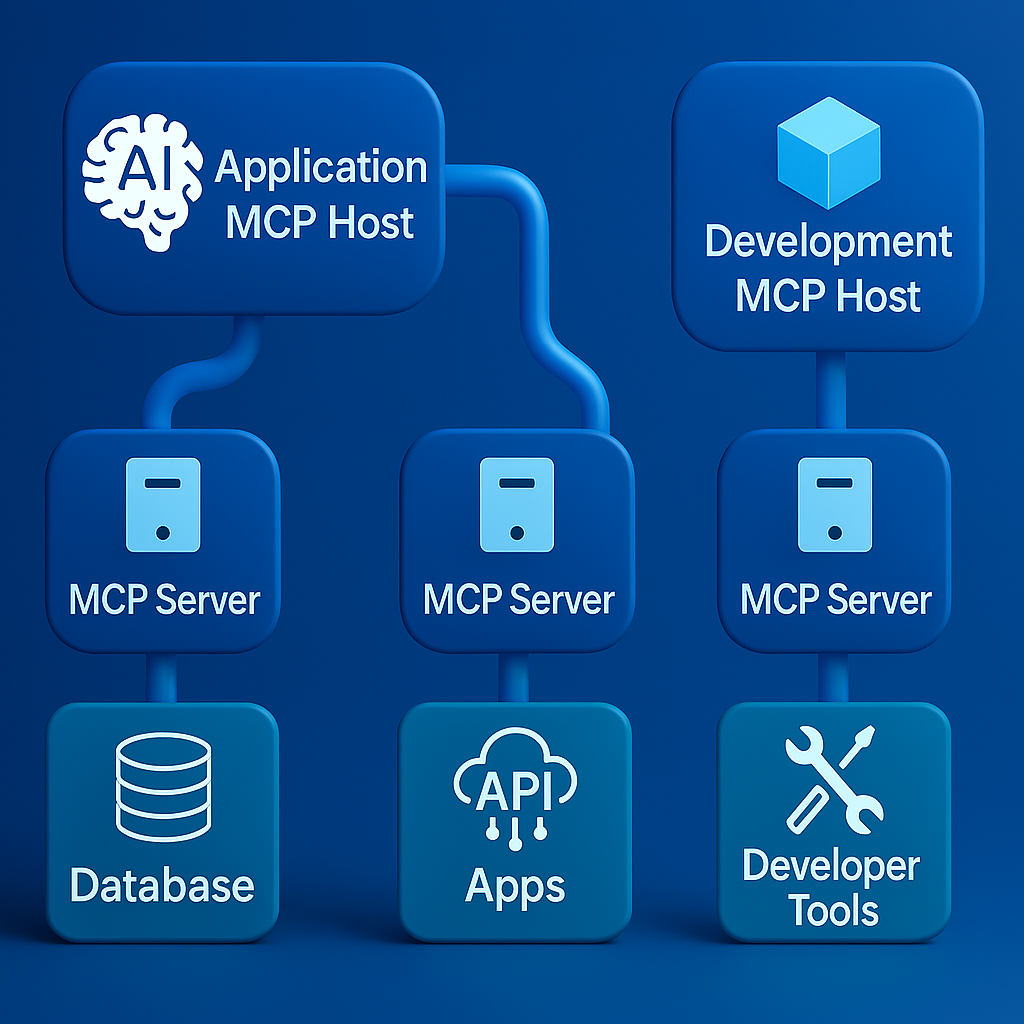
Initially developed by Anthropic and later adopted by OpenAI, MCP is an open, standardized protocol that securely connects AI assistants and large language models (LLMs) to various internal and external data sources and tools. From a security standpoint, MCP acts as an organization's standardized communication layer for AI, comparable to a secure API gateway. This design promotes scalable and reliable integrations, consistent governance, and secure data handling.
Primary Benefits of MCP for Security Teams:
- Centralized visibility and governance of tools
- Standardized, easily integrated, AI integrations
- Unified access management and security control enforcement
- Scalable, flexible deployments
By adopting MCP, organizations can effectively address and mitigate key AI security risks outlined in the OWASP Top 10 for LLMs:
- Excessive Agency (LLM06:2025): MCP centralizes tool inventory and permissions, preventing AI systems from gaining excessive or unauthorized capabilities.
- Sensitive Information Disclosure (LLM02:2025): MCP enables consistent authentication and authorization, reducing risks of unauthorized data exposure.
- Unbounded Consumption (LLM10:2025): Operational policies like rate limiting can be applied more easily with MCP-based architecture in order to prevent AI systems from consuming excessive resources.
- Prompt Injection (LLM01:2025): MCP-enabled centralized logging and monitoring allows quick detection of malicious input designed to manipulate AI behavior.
Cautionary Note: While MCP offers substantial security benefits, it must be approached with the same diligence and governance as any third-party library integration. Connecting to untrusted MCP servers can expose organizations to serious supply chain risks, potentially leading to significant security breaches.
A Detailed Look at MCP's Security Capabilities
1. Enhanced Visibility and Governance
By centralizing AI tools and leveraging MCP's upcoming auto-discovery feature (rolling out in H1 2025), MCP will empower security teams to establish and maintain a unified inventory of all integrated tools, mitigating the risk of Excessive Agency, as presented in OWASP Top 10 LLM. This streamlined approach offers:
- Simplified Detection of Shadow Tools: Instead of the current scenario where tools and agents are defined individually across various codebases, a centralized inventory facilitates quick identification and remediation of redundant, malicious or unauthorized "shadow" AI tools, mitigating Excessive Functionality (a sub-type of Excessive Agency).
- Built-in Centralized Authorization: MCP’s centralized authorization mechanism (also scheduled for H1 2025) enables security teams to manage and streamline tool permissions effectively, assigning access clearly by department, role, or use case. This significantly reduces the risks of unauthorized access and Excessive Permissions (yet another sub-type of Excessive Agency).
- Integration with Automated Security Controls: By leveraging MCP servers for tool access, organizations can enable seamless integration with AI/ML security solutions that facilitates automated audits of the tool inventory, allowing security teams to quickly detect and respond to critical events, such as the addition or modification of tools with excessive permissions or the emergence of vulnerable/malicious tools.
2. Unified and Secure Access Management
Using MCP as the centralized gateway for accessing AI tools significantly enhances security management by enabling precise and consistent control over tool usage through a single access layer:
- Secure and Controlled Access: By routing all interactions through MCP’s centralized access point, security teams can more easily implement:
- Security controls such as authentication (scheduled for release in H1 2025) can be uniformly enforced, protecting against unauthorized use, misuse, and impersonation threats that may cause Sensitive Information Disclosure (OWASP 10 LLM02:2025).
- Operational policies such as rate limiting and throttling can be consistently applied, safeguarding tools from overload and preventing Unbounded Consumption (OWASP 10 LLM10:2025)
- Enhanced Ahttps://https://noma.security/wp-content/uploads/Preview-Image.png.security/wp-content/uploads/Noma-Launch-Team-Photo.pngly Detection: Centralized logging and monitoring within MCP can help establish a usage baseline, which in turn can be used to identify abnormal behaviors, often occurring due to malicious input such as Prompt Injection (OWASP 10 LLM01:2025).
3. Robust and Scalable Deployment
MCP enhances the robustness and scalability of AI deployments by separating AI systems from their associated tools:
- Flexible and Scalable Infrastructure: By separating resource-intensive AI models (typically GPU-driven) from tool integrations (typically CPU/IO-bound), MCP allows DevOps and security teams to scale resources independently (for example, using a serverless environment), optimizing cost and performance while adhering to security best practices.
- Customized Security Policies: Distinguishing between non-deterministic AI components and deterministic tool integrations enables tailored security measures. Some examples are:
- A domain allow-list can be more easily implemented when separating AI-driven web browsing tools which might require general web access, and deterministic tools accessing specific REST APIs can have tightly controlled permissions.
- Tool Isolation: Non-deterministic or potentially volatile tools, like code interpreters, can be deployed in isolated environments with strict containment, significantly limiting opportunities for lateral movement or unintended access.
Takeaways
Security teams considering adopting MCP should follow these recommendations to enhance security effectively:
- Utilize security tools that can seamlessly integrate with MCP servers to automatically discover, identify, and manage shadow, unused, malicious or deprecated tools.
- Establish Comprehensive Logging mechanisms to develop clear usage baselines, enabling security tools to quickly identify and respond to ahttps://https://noma.security/wp-content/uploads/Preview-Image.png.security/wp-content/uploads/Noma-Launch-Team-Photo.pnglies that may indicate misuse or potential threats.
- Enforce Centralized Security and Operational Controls: Implement the centralized security and operational controls discussed in this article, including authentication, authorization, encryption, rate limiting, and isolation of tools.
- Conduct Red Team Exercises: Regularly employ red teaming tools and exercises that specifically account for MCP-integrated tools, proactively uncovering and mitigating potential vulnerabilities.
- Avoid integrating with untrusted MCP servers that may introduce supply chain risks to your organization
Adopting MCP provides significant advantages for securing AI systems within organizations, offering enhanced visibility, centralized control, and robust deployment strategies. As AI integration complexity grows, embracing MCP's standardized approach equips security teams with the necessary tools to effectively manage emerging risks and confidently secure their organization's AI future.
To learn more about how Noma can help you on your AI Security journey, contact us.



.png)

.png)