The Architectural Evolution of NanoClaw and Enterprise Platform Risk

Autonomous agentic frameworks continue to transform towards more minimalist, security-focused architectures. Early frameworks, such as OpenClaw, prioritized shipping fast, feature promises and desktop-level parity. However, their broad codebase and open default configurations introduced significant systemic vulnerabilities that are difficult to manage in production.
The Rise of NanoClaw
NanoClaw (currently at 26,000 GitHub stars and still climbing) has emerged as a leading leaner alternative. It was specifically engineered to solve the isolation failures seen in earlier agent deployments. By reducing the attack surface, it claims to offer a more controlled environment for executing autonomous tasks.
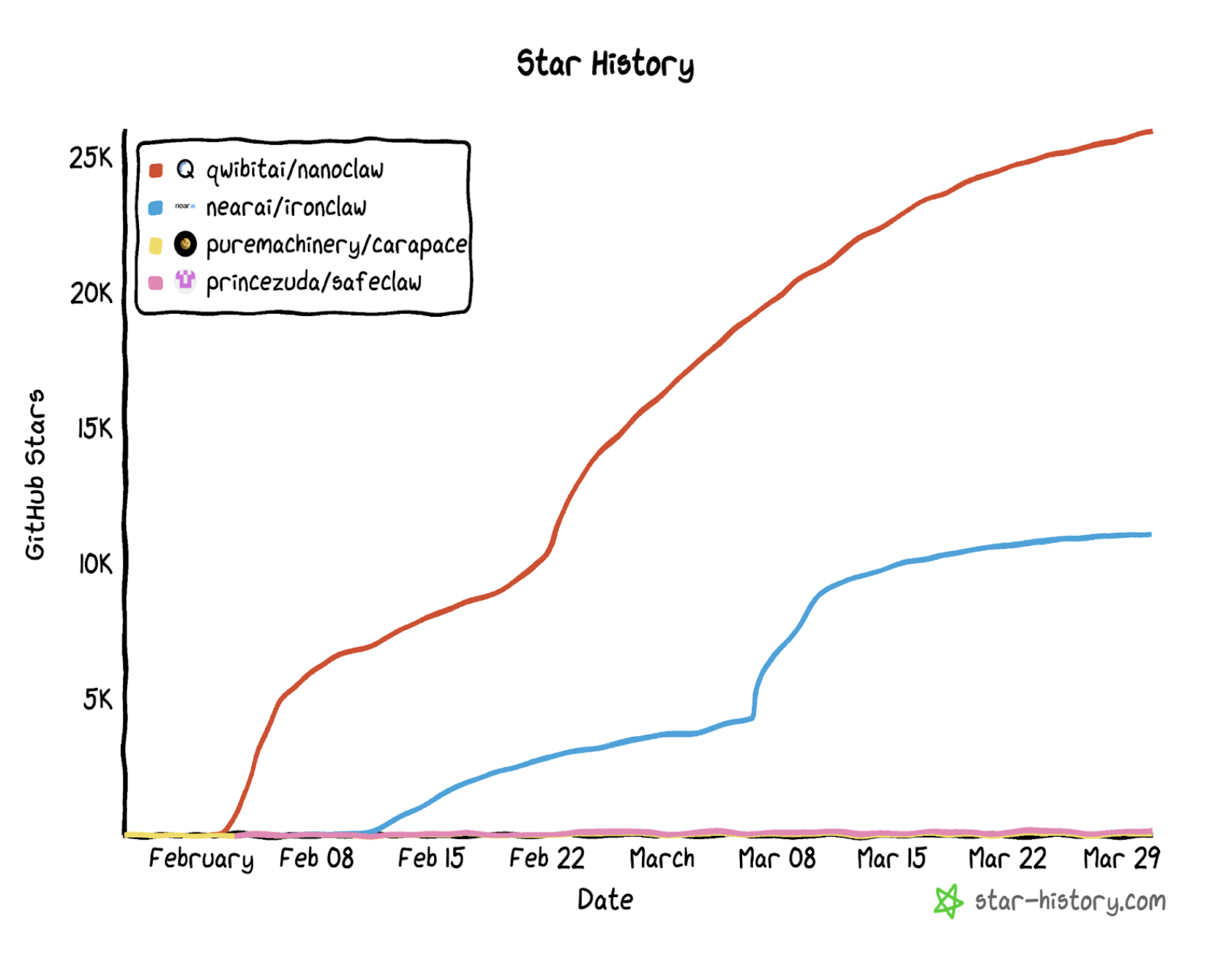 Star History: GitHub star growth comparison of leading agentic frameworks (source: star-history.com)
Noma's Security Assessment
To determine if NanoClaw is truly enterprise-ready, Noma's research team performed a technical deep dive into its architecture. Our analysis focuses on the structural gaps between these types of "Claw" frameworks and defines the specific security controls required for a resilient deployment.
Threat Landscape Shifts: From OpenClaw to NanoClaw
The significant vulnerabilities associated with OpenClaw are well-documented in our previous blogs and by countless other security researchers. Its reliance on host-level execution and complex, optional sandboxing led to widespread, catastrophic exploits. Attackers frequently used indirect prompt injection to bypass isolation or exploited the lack of origin validation in its WebSocket implementation.
NanoClaw represents a departure from this model by making isolation a functional dependency. During RSAC, we heard from the field of adoptions for high-stakes enterprise tasks, including:
- Business Users: Marketing, Sales, RevOps, and Finance teams deploying as a digital workforce to automate high-stakes, high-risk workflows, such as reconciling sensitive Finance, CRM, and ERP data, managing 24/7 channel and funnel development and pipelines, and performing automated content and contract reviews.
- Automated DevOps Pipelines: Managing ephemeral infrastructure where credential leakage must be contained.
- Customer Support Agents: Interacting with live user data through messaging platforms like Slack or WhatsApp.
- Internal Data Analysts: Processing sensitive financial or HR documents within restricted environments.
Technical Deep Dive: Isolation and Permission Models
Our initial investigation identified three primary areas where NanoClaw changes the security boundary for autonomous agents.
1. Mandatory Sandboxing and Least Privilege
NanoClaw removes the "opt-in" nature of security. The agent cannot run without a containerized environment (Docker on Linux or Apple Containers on macOS).
- Process Isolation: Unlike in OpenClaw, where the Gateway (GW) process, including the agent, frequently runs on the host with user-level permissions, in NanoClaw, every agentic component is sandboxed, with only the orchestrator process unsandboxed.
- User Identity: The agent operates as an unprivileged user inside the container. This prevents an agent from inheriting the host user's full filesystem permissions, a common failure point in OpenClaw deployments.
2. Cross-Message Group Segregation
A critical security flaw in previous frameworks was the use of "shared memory" between different conversation threads. If multiple users interacted with the same agent, the agent could potentially leak PII, PHI, or Secrets from one user's history to another.
NanoClaw enforces a per-group isolation model. Each message group is assigned:
- A dedicated, isolated container.
- Private memory and context files.
- A specific mount allowlist instead of broad filesystem access.
3. Codebase Auditability and Skill Generation
OpenClaw consists of several hundred thousand lines of code, making a full security audit impractical for most organizations. NanoClaw contains approximately 3,900 lines of code across only 15 files. This reduction in complexity decreases the unintended attack surface.
However, NanoClaw's capability to "write its own skills" introduces a new risk. A NanoClaw agent could be manipulated via prompt injection to generate a skill containing a backdoor or a typosquatted dependency. Because the framework is minimalist, it relies on the user to validate any code the agent generates before it is merged.
Comparative Risk Matrix
| Risk Factor | OpenClaw / MoltBot | NanoClaw |
|---|---|---|
| Execution Environment | Host-based by default; sandbox is optional. | Container-based; sandbox is mandatory. |
| Identity Management | Inherits host user permissions. | Uses unprivileged container identity. |
| Persistence & Memory | Shared context across message groups by default. | Isolated memory per message group. |
| Skill Management | Large, unvetted third-party marketplace. | Skills are added on demand, written manually or generated; no public marketplace. |
| Auditability | High complexity; difficult to verify. | Low complexity; 3,900 lines of code. |
Noma Security Recommendations for Enterprise Security Teams
For organizations deploying NanoClaw, we recommend the following controls to mitigate the risks associated with autonomous agency:
- Restrict Filesystem Mounts: Use the mount allowlist to ensure the agent only has access to ephemeral directories. Always avoid mounting sensitive paths such as ~/Documents. Note: Some sensitive paths such as .ssh, .gnupg, .aws, .azure, .gcloud, .kube, .docker, .credentials and more are already blocked by default, see: https://github.com/qwibitai/nanoclaw/blob/main/docs/SECURITY.md#2-mount-security for additional details.
- Enforce Read-Only Access: Utilize the nonMainReadOnly setting to restrict write permissions for any group not designated as an administrator.
- Monitor Agent-Generated Skills: Implement a mandatory review process for any new code written by the agent. Skills should be scanned for malicious patterns and unauthorized network calls before activation.
- Isolate Credentials: Use the integrated agent vault for secret management. Do not pass sensitive API keys as environment variables, which can be easily exfiltrated in a container compromise.
The Role of Noma's AI Security Platform
Framework-level security is a necessary foundation, but it does not replace the need for enterprise-grade runtime protection and oversight. Noma provides a critical governance and proactive defensive layer for NanoClaw deployments by:
- Detecting Shadow Agents: Identifying unauthorized NanoClaw instances across the corporate network.
- Runtime Threat Detection: Identifying and intercepting live exploits such as indirect prompt injections, unauthorized tool calls, and data exfiltration attempts. Noma monitors the communication between the agent, the LLM, and the host in real time, providing a critical safety net that blocks malicious activity before it can bypass the container's structural boundaries.
- Automated Skill Scanning: Analyzing agent-generated code in real time to prevent the introduction of vulnerabilities or malicious dependencies.
By combining NanoClaw's isolated architecture with Noma's visibility and control, organizations can leverage agentic AI without compromising their security posture.