
As your enterprise AI adoption transitions from experimental sandboxes to fully integrated workflows and autonomous agents, your security organization faces a new mandate: proving that your AI Management System (AIMS) actually works as designed.
Published in late 2023, ISO/IEC 42001 quickly emerged as the definitive global standard for AI governance. As of September 2026, more than 350 organizations worldwide have achieved certification, but many leaders have hit an operational roadblock: the evidence gap.
ISO 42001 does not certify an isolated machine learning model. Instead, it certifies the operational effectiveness of your governance processes over time. Most Governance, Risk, and Compliance (GRC) tools excel at managing static documentation, such as policies, roles, training, and internal audit plans. However, ISO 42001 certification hinges on the ability to document your ongoing operational effectiveness, which requires continuous technical telemetry from your live AI estate.
Here’s how your team can easily bridge the gap between static paperwork and the living technical evidence to achieve continuous ISO 42001 audit readiness.
ISO 42001 Tasks: GRC vs. Technical Evidence
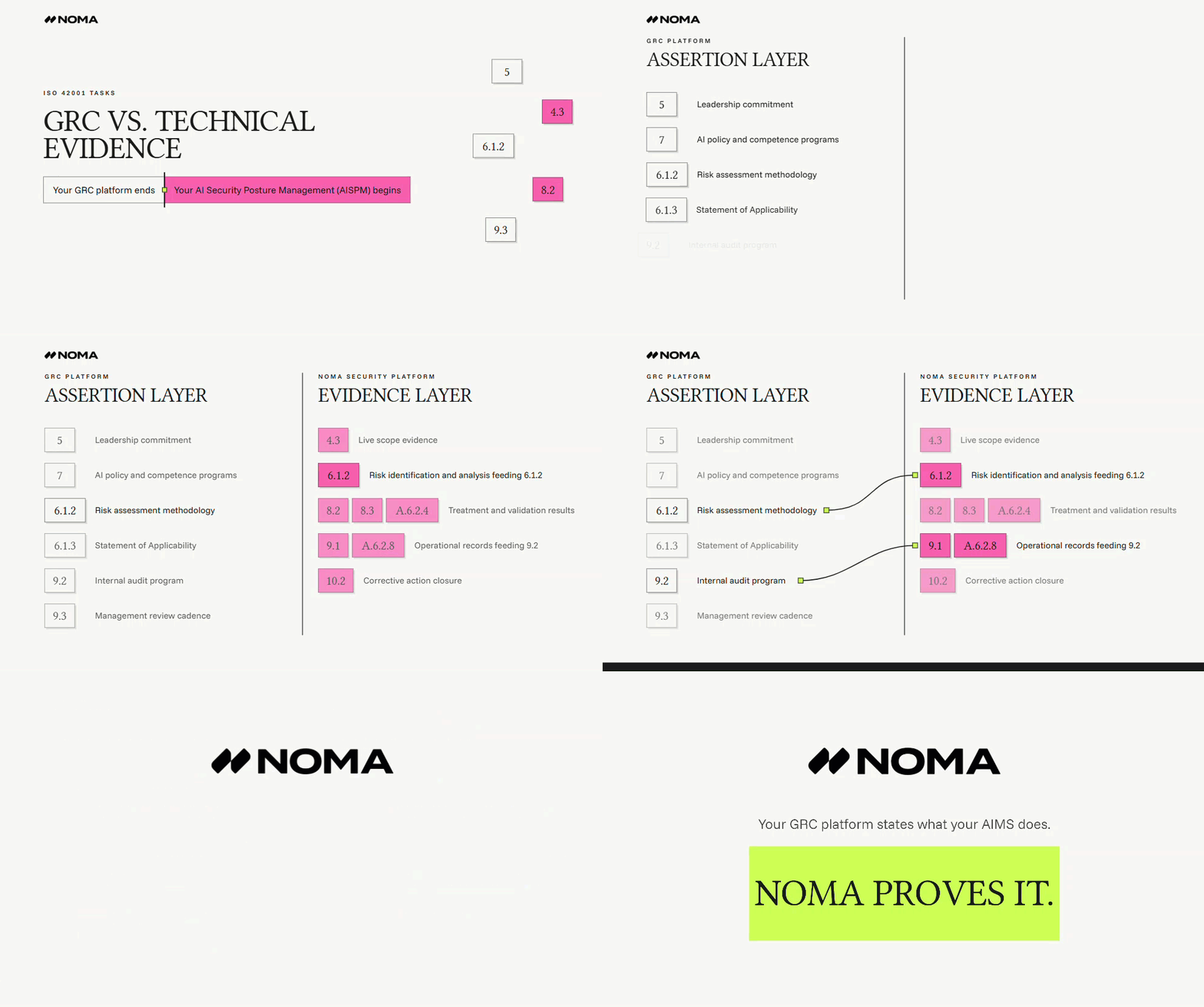
To avoid audit friction, you must delineate where your GRC platforms end and where your AI Security Posture Management (AISPM) solution begins.
- GRC Platform (Assertion Layer): Begins with the leadership commitment (Clause 5), AI policy and competence programs (Clause 7), the risk assessment methodology itself (6.1.2), the Statement of Applicability (6.1.3), the internal audit program (9.2), and management review cadence (9.3).
- Noma Security Platform (Evidence Layer): the technical inputs and outputs that those documents assert. Live scope evidence (4.3), risk identification and analysis feeding 6.1.2, treatment and validation results (8.2, 8.3, A.6.2.4), operational records (9.1, A.6.2.8), and corrective action closure (10.2).
Note: The true split isn't clause-by-clause, but rather assertion versus evidence. Your GRC platform states what your AIMS does, and Noma proves it.
Mapping Noma Technical Telemetry to Mandatory ISO 42001 Clauses
Noma maps continuous technical evidence directly to the mandatory clauses and Annex A controls required according to the applicable controls in Clause 6.1.3.
1. Defining AIMS Boundary & Inventory (Clause 4: Context of the Organization)
Auditors will test your declared scope against what is actually running in production. Point-in-time surveys fail to capture shadow AI, unmanaged agents, or rogue MCP integrations.
- The Technical Evidence: Noma’s AISPM discovers every AI resource across your environment. This includes Shadow AI adopted outside governance workflows. This live inventory forms the verifiable boundary of your AIMS scope and automatically stays up to date.
2. Living Risk Assessments (Clauses 6.1 & 8.2: Planning and Operation)
Clause 6.1 requires a structured risk assessment process, while Clause 8.2 mandates that these assessments be performed at planned intervals and whenever significant changes occur.
- The Technical Evidence: Static spreadsheets fall short when models or agent permissions update daily. Noma continuously evaluates risk, producing severity-scored findings stamped with the exact evaluation date and associated AI asset. This provides auditors with traceable proof of periodic and change-triggered risk evaluations.
3. Risk Treatment Verification & Red Teaming (Clause 8.3: AI Risk Treatment)
Documenting a control selection is not enough; Clause 8.3 requires proof that selected treatments actually mitigate identified AI risks.
- The Technical Evidence: Noma AI Red Teaming continuously tests deployed agents against security boundaries. When vulnerabilities are remediated, Noma automatically retests the agent and records the pass/fail history, providing risk owners with validated evidence before signing off on residual risk.
4. Continuous Runtime Monitoring (Clause 9: Performance Evaluation)
Clause 9.1 requires you to determine what to monitor, how to measure it, and when to measure it. Finally, you must evaluate the results. Clause 9.3 requires management review to explicitly include monitoring results and nonconformities, and suggests the inclusion of corrective actions. And because accredited certification runs on a three-year cycle which includes: initial audit, surveillance in years one and two, recertification in year three (ISO/IEC 17021-1), your evidence has to already exist, not be assembled the week before the auditor arrives as required in A.6.2.8. Noma’s audit log provides the full audit trail and recording as required.
- The Technical Evidence: Noma AI Detection and Response (AIDR) acts as the continuous operational recorder. It logs what each agent executed, runtime policy violations, blocked prompt injections, and incident resolution trails. Runtime AI-DR creates a timestamped, unalterable record for management reviews and annual audits.
5. Least Privilege & Human Oversight (Annex A: Lifecycle & Responsible Use Controls)
Annex A includes 38 controls covering responsible use, access control, and human oversight. Agentic workflows introduce complex non-human identity challenges that are near-impossible to track manually.
- The Technical Evidence: Noma AIDR enforces Human-in-the-Loop (HITL) requirements by blocking sensitive agent actions until human approval is logged. Noma Agent Access Control enforces least-privilege policies by restricting which MCP servers and tools an agent can reach. Every agent is attributed to a specific owner, providing a clean audit trail from onboarding to decommissioning.
Audit Readiness Is Continuous, Not Episodic
Achieving ISO 42001 certification isn't about producing hundreds of pages of documentation right before auditor arrival. By pairing your organizational GRC framework with an AI Governance and Security solution like Noma's automated technical evidence layer, your enterprise transforms compliance from a disruptive annual event into a continuous background process.
Ready to get started? Request Noma's ISO/IEC 42001 Technical Compliance Audit Prep Guide here.