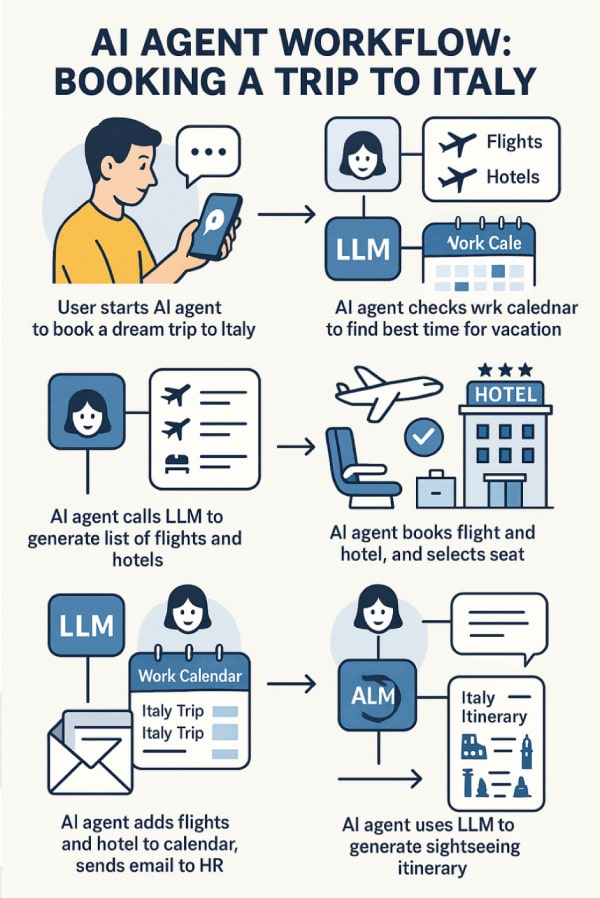
Blog 1.2 AI Agent Basics: Workflow
An agentic workflow is the structured process that allows an AI system to take in information, interpret it, make decisions, and then act through connected tools or systems. At its core, an agentic workflow links perception, memory, reasoning, and action into a repeatable business process loop. This workflow is what transforms an AI agent from a chatbot into a goal-driven system capable of handling complex, end-to-end tasks.
Protocols
For functionality, agents need to understand inputs from people and systems and exchange information with other agents or services. That means understanding inputs from people and systems, while also being able to exchange information reliably with other agents and services. For usability and ease of integration these protocols should support interoperability and standardization. Two of the most important protocols in use in agentic AI today are Agent-to-Agent (A2A) and the Model Context Protocol (MCP).
- Agent-to-Agent (A2A): Think of this as the collaboration protocol. It allows agents to discover each other, share context, and hand off tasks without losing important details. Much like a team passing a project from one department to another, A2A ensures continuity and accountability in complex workflows.
- Model Context Protocol (MCP): This is the connection standard. It gives models and agents a consistent, secure way to locate and interact with enterprise systems such as email servers, databases, or ticketing platforms. Without MCP, each connection would be a bespoke integration, brittle and difficult to scale.
Perception
The first step in an agentic workflow is perception. Just as humans rely on their senses, AI agents rely on inputs. An input can be as simple as a user typing a request into a chat window or as complex as sensor data flowing in from physical systems such as industrial pressure and temperature sensors in freezer units spanning a national grocery store chain.
Data collection of inputs happens across multiple streams. It can include textual data like user queries, documents, log files, or emails. It can also include visual data such as images or video feeds, auditory data such as voice commands or environmental sounds, and sensor data from APIs, databases, or IoT devices.
The agent also applies contextual interpretation to the input as part of the perception process. That means extracting relevant features, recognizing patterns via machine learning, and understanding what those inputs mean within a specific environment. Consider that a customer query to an online retailer about “late delivery” is not just text, it is a signal that connects to order data, shipping logs, driver telemetry, and support policies. Perception transforms input into understanding and enables decision making.
Planning and Reasoning
Once the agent has perceived its environment, the next step is planning and reasoning. Here, the system interprets the goal, breaks it into manageable steps, and decides on a strategy to achieve it. This begins with goal analysis. A user may say, “Generate a weekly risk report.” The agent must interpret what that looks like. Using large language models for reasoning, the agent creates a plan to complete the subtasks.
To do this often requires task decomposition since complex goals are rarely handled in one step. For a risk report, it could mean pulling logs, running analysis, and formatting results. The LLM performs the reasoning, breaking down the tasks in steps that the agent or agents can then act on as part of an execution plan.
Many agent frameworks are built on the ReAct (Reason -> Act) paradigm, which structures how agentic workflows operate. In practice, this means that as new information arrives, the language model can pause, re-evaluate its reasoning, and adjust the plan before moving forward. Take the example of the weekly risk report: if the agent is compiling data and, at the last moment, a new zero-day vulnerability is discovered, the model reassesses the findings, incorporates the new attack details, and then instructs the agent to finalize formatting and distribute the updated report. This ability to integrate fresh intelligence midstream is what separates agentic workflows from static automation and makes them so valuable.
Execution and Tool Calling
In this phase, the agentic system carries out the parts of the plan that can’t be completed by the LLM or agent by calling other tools and interacting with the environment. Tool use is central and this is why protocols like MCP are so important to the process. The agent must be able to access APIs, query databases, run code, or connect to SaaS platform tools like email. For example, a customer service agent may retrieve account details from a CRM or update a ticketing system with a resolution. Execution transforms reasoning into outcomes.
Reflection and Learning
What makes a workflow truly agentic is not just acting but learning. Reflection is the final stage where the agent evaluates its performance and, hopefully, improves over time. Evaluation begins by comparing results against the original goal. Did the generated report match compliance standards? Did the customer receive the correct version?
Adaptation follows evaluation. The agentic system refines its strategy based on what worked and what did not. Over time, it should develop stronger patterns, reduce errors, and become more effective in dynamic environments.
Example: Planning Your Dream Trip to Venice
To see this in action, imagine that you ask your agent: “Book me a dream trip to Venice in May. I want a boutique hotel near the canals, direct flights if possible, and a cooking class while I’m there.”
- Protocols: Throughout the process the agent uses communication protocols like MCP to connect with booking and financial systems and A2A to collaborate with specialized travel and scheduling agents.
- Perception: It interprets your requirements, checks your work calendar to find an optimal time to travel, assesses your travel history to determine that you prefer morning flights and window seats, and pulls relevant flight and hotel data.
- Planning and Reasoning: The agentic system, using the LLM for reasoning, breaks the request into sub-tasks: find and book flights, select seats, search for preferred hotels, check local guides to confirm available, seasonal, activities, and designs a plan.
- Execution: The agent or agents call tools and books flights, reserves a boutique hotel, schedules the cooking class, emails HR to take time off, and sends confirmations.
- Reflection and learning: The agent logs every action, confirms accuracy, identifies areas for improvement, and stores your preferences for future travel.